
"We already have automation in the company. Why would we need AI?" That's the question 80 % of founders ask us on the first call. And it's a fair question.
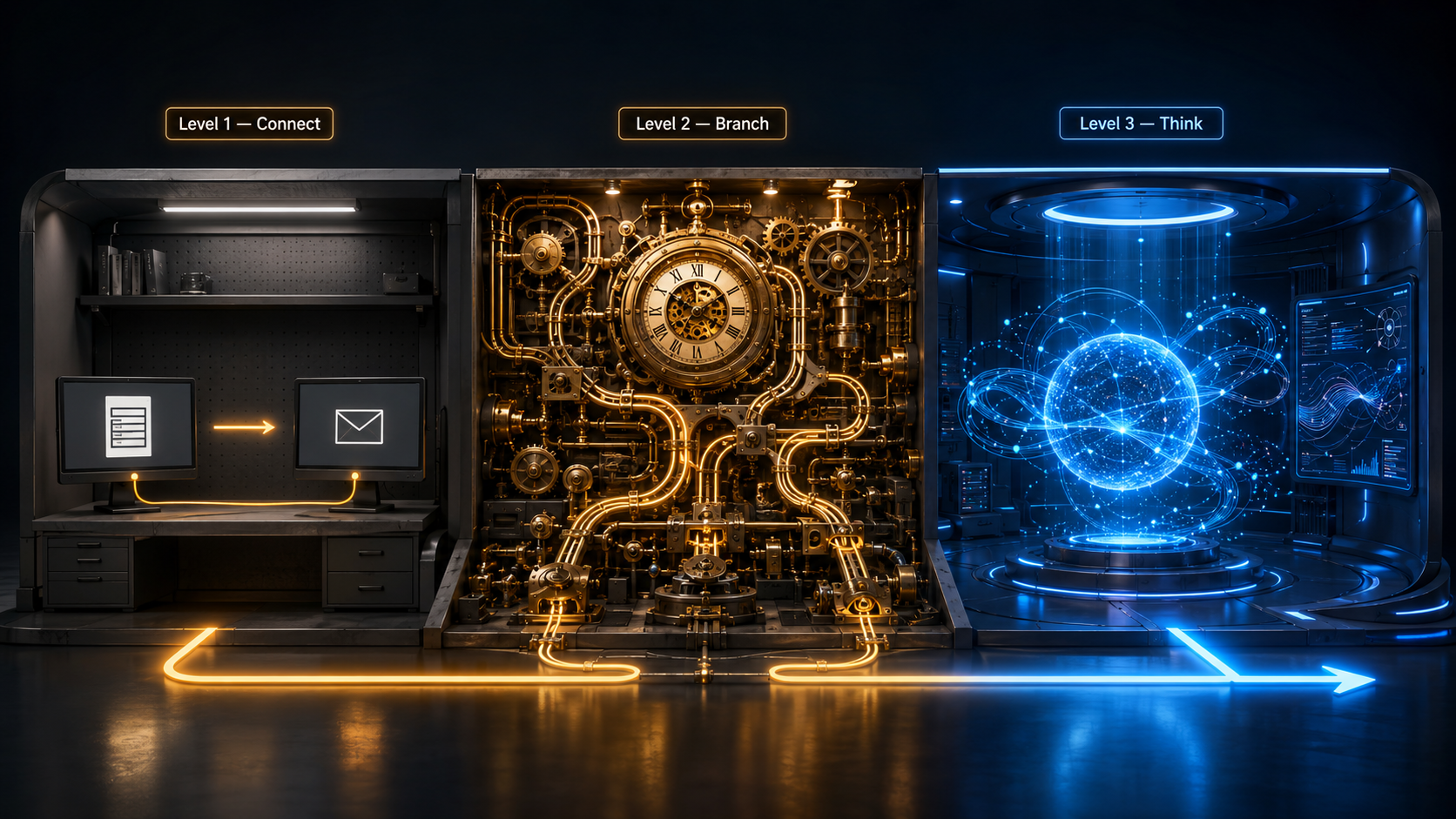
The problem is that it rests on a fundamental confusion. Under the word "automation," three very different technologies coexist. They don't solve the same problems, don't cost the same, and don't produce the same results. Here are the three levels, explained with real use cases, so you know exactly where you stand — and what you're missing.
Three levels, three different worlds
Before diving in, here's the framework:
📊 The three automation levels
• Level 1 — Basic automation: fixed if/then rules. Tools: Zapier, IFTTT.
• Level 2 — Advanced automation: multi-step workflows with conditional logic. Tools: Make, n8n.
• Level 3 — Specialized AI system: contextual understanding and decision-making. Tools: tailor-made AI layers like NovekAI.
Each level is useful. None replaces the others. But each level solves a different kind of problem. Confusing them guarantees disappointment and wasted budget.
Level 1: Basic automation (Zapier, IFTTT)
This is the automation you know best. A simple condition, a simple action. If X happens, then Y triggers.
What it does well
Connect two tools together to sync data. Form filled on your site → create a row in Google Sheets. Email comes in → send a Slack notification. Deal closed → add the client to Mailchimp.
Where it stops
The moment a decision has to be made, it's over. Zapier can't read an email's content to decide whether to route it to rep A or rep B. It can't qualify a lead based on contextual criteria. It can't adapt its reply to the prospect's profile.
🔍 Typical use case
Marketing agency with a Zap: "When a lead fills the form, add to HubSpot + send a generic auto-reply."
✅ Lead is recorded.
❌ Lead receives the same email as everyone else. No qualification. No personalization. Meeting conversion: 8-12 %.
Level 2: Advanced automation (Make, n8n)
One step up. Multiple steps, multiple conditions, conditional branches. If X AND Y, then Z. Otherwise, do W.
What it adds
More complex workflows: you can route emails based on rules, trigger sequences from behavior, enrich data via APIs. Much more powerful than Zapier, but still deterministic: every rule has to be coded upfront.
Where it stops
The moment an unanticipated case arrives, the workflow breaks or produces an absurd output. If the form has a field that wasn't planned for, if the lead expresses an unusual request, if the context shifts, the system can't adapt. You go back to Make and code another branch.
Result: a Make workflow that works today turns into an unmaintainable plumbing nightmare in 6 months.
🔍 Typical use case
Consulting firm with a Make workflow: "If lead comes from LinkedIn AND company has 50+ employees → assign to senior. Else → assign to junior."
✅ Decent initial segmentation.
❌ Doesn't read the actual request, doesn't pick up urgency, doesn't tailor the reply. Meeting conversion: 15-20 %.
Level 3: Specialized AI system
Now we shift paradigm. You don't code rules anymore — you train a system to understand, qualify and decide in your business context.
What changes radically
The AI system can:
- Read and understand a message's content, not just its metadata
- Infer context (a message at 11 PM on a Sunday doesn't mean the same as one at 10 AM on a Tuesday)
- Adapt its reply to sector, size, lead maturity
- Learn from edge cases instead of requiring a coded rule for each exception
- Make decisions that weren't anticipated by the original rules
It's the difference between an employee who follows a strict manual (Level 2) and an employee who understands the spirit of your business and applies it to the cases they encounter (Level 3).
🔍 Typical use case
Same consulting firm with an AI Appointment Setter: "Lead arrives → system reads the message, identifies the sector, picks up an urgency signal in the tone, cross-references the DB to see if the company is already a client, generates a sector-specific reply, offers 2 slots with the right senior."
✅ Contextual conversation from second one.
✅ No rules to maintain: the system handles unanticipated cases.
Meeting conversion: 30-40 %.
How to know which level you need
Ask yourself three questions:
1. Does a contextual decision need to be made?
If yes (qualification, smart routing, prioritization), you need Level 3. Zapier and Make won't cut it.
2. Are the cases you handle stable and limited in number?
If yes (simple syncs, notifications), Level 1 or 2 is more than enough. Don't bring AI in.
3. Does improving processing quality generate significantly more revenue?
If yes (sales, support, qualification), Level 3's ROI is unbeatable. If not (low-value admin tasks), stay at Level 1 or 2.
The cost-benefit reality
For perspective, typical orders of magnitude:
💰 Annual economic comparison
• Level 1 (Zapier): $300 to $1,000/year. Setup: 2-5 days.
• Level 2 (Make + integrator): $3,000 to $15,000/year. Setup: 2-6 weeks. Regular maintenance needed.
• Level 3 (Specialized AI system): $15,000 to $45,000/year. Setup: 3-6 weeks. Very little maintenance.
The classic trap: trying to do Level 3 with Level 2 tools. We regularly see SMBs that spent 8 months building a hyper-complex Make workflow to simulate intelligent qualification. End result: $30K in services, an unintelligible workflow, disappointing results. With that budget, a specialized AI system would have outperformed it from month one.
The right order
The mistake isn't using Zapier or Make. These tools are excellent for what they are. The mistake is asking them to do what they can't.
The right order for a B2B SMB: Level 1 for simple syncs (always), Level 2 for internal operational workflows (often), Level 3 for critical sales and support functions (where every quality improvement generates direct revenue).
Let's identify the right level for you
In a 30-minute free audit, we map your current processes and identify where Level 3 (specialized AI) generates the highest ROI for your business.
Book my audit →