
A lead contacted within 5 minutes is 21 times more likely to qualify than one contacted at the 30-minute mark. That data comes from Harvard. And yet, the average B2B response time is still 42 hours.
This isn't a footnote. It's the most ignored statistic in modern B2B sales — and probably the highest-ROI lever you currently have available. Here's exactly what the studies say, and why hitting the 5-minute mark has become impossible without an operational AI layer.
The Harvard study no one acts on
In 2011, Harvard Business Review published a now-famous study: "The Short Life of Online Sales Leads." Researchers analyzed 1.25 million leads from 29 U.S. B2B and B2C companies. The findings are brutal.
📊 Key Harvard findings
• Companies that contact a lead within the first hour are 7 times more likely to qualify that lead than those who wait even one more hour.
• Compared to those who take 24+ hours: 60 times more likely.
• And at the 5-minute mark: ×21 vs 30 minutes.
Even more striking: only 37 % of companies in the study responded within an hour. More than 24 % never responded at all.
What 5 minutes actually means
5 minutes isn't an arbitrary marketing target. It's a precise psychological window. In that window, your lead is still:
- Mentally present with your brand (they just filled out your form)
- Physically available (they're still at their screen or phone)
- Comparing (they likely filled out 2-3 competitor forms too)
After 5 minutes, attention shifts. At 30 minutes, they're in a meeting. At 2 hours, they've forgotten your name. At 24 hours, you're one email buried among 80 others.
The cliff that happens after 1 hour
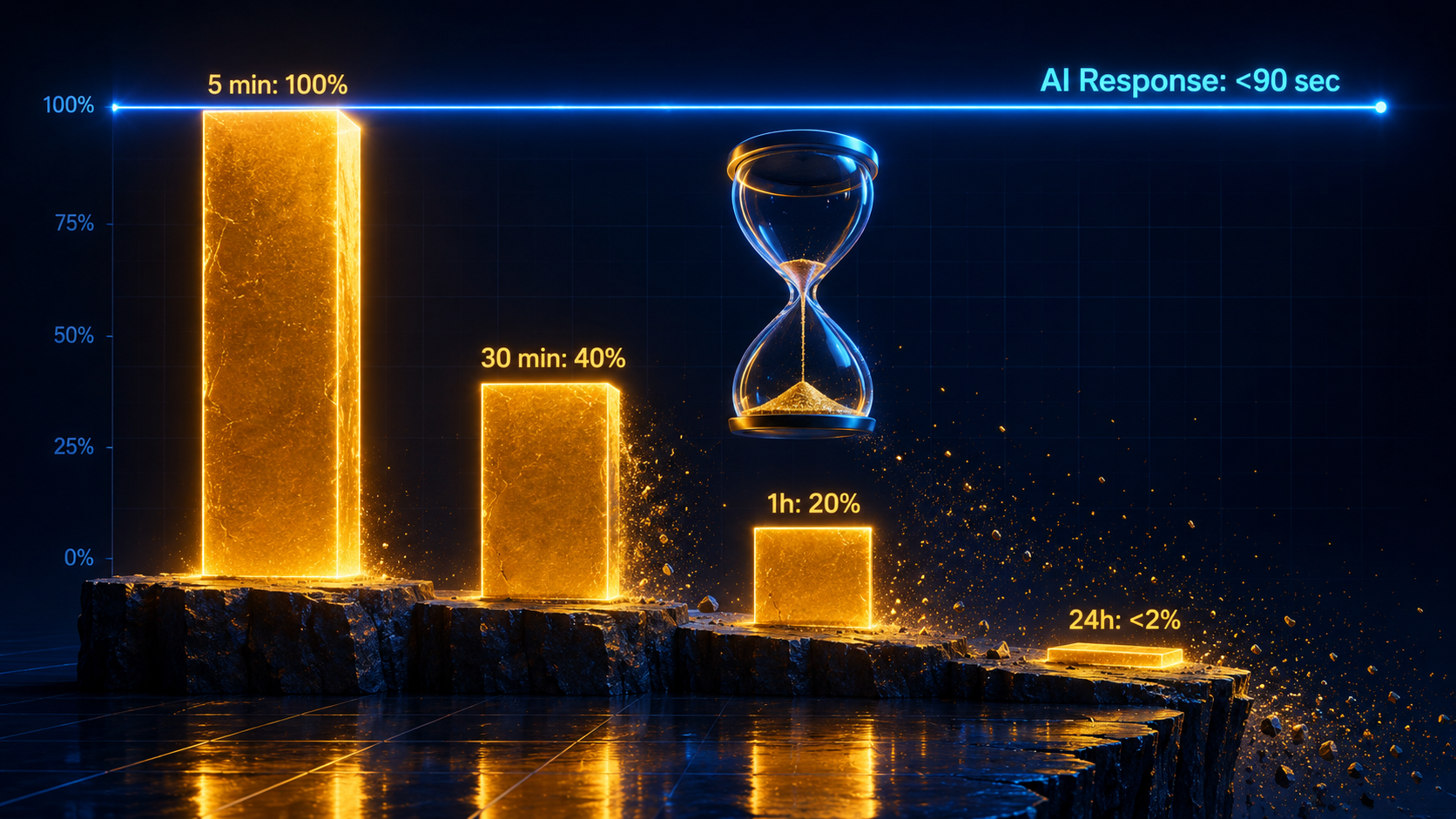
InsideSales (now XANT) data confirms the cliff effect. Lead qualification rate doesn't decay linearly over time. It collapses.
🔍 Qualification rates observed by response time
• 0-5 minutes: 100 % (baseline)
• 5-10 minutes: 80 %
• 30 minutes: 40 %
• 1 hour: 20 %
• 5 hours: 6 %
• 24 hours: less than 2 %
Practically: a lead you process at H+24 has under a 2 % chance of leading to a qualified conversation. You paid to generate that lead, and statistically you already know it's dead.
Why your team can't hit this standard
It's not a willingness problem. Your reps know they need to respond fast. It's a structural problem.
The math problem
Picture an agency receiving 80 leads per month — roughly 4 per business day. To respond under 5 minutes to every lead, a rep would need to be available to react instantly, at any moment of the day. Including when they're in a client meeting, on lunch break, or in an internal review.
Mathematically, hitting 5 minutes 100 % of the time requires either an oversized team (minimum 3 dedicated SDRs in rotation) or a system that never sleeps.
The workflow problem
Even when a rep is available, you still have to account for:
- Receiving the notification
- Opening the CRM
- Reading the form
- Checking whether the lead is qualified
- Writing a personalized reply
- Sending it
That path alone takes 8 to 12 incompressible minutes, even for an excellent rep. The 5-minute bar is physically out of reach for a human.
The 24/7 problem
40 % of B2B form submissions happen outside business hours: early mornings, evenings, weekends. A lead who fills your form on a Sunday at 9 PM and waits until Monday at 10 AM gets a reply… 13 hours later. That's 156× the optimal 5-minute window.
What real-time response actually looks like
A well-designed AI system doesn't just send a generic auto-reply. It does in seconds what takes a human 10 minutes:
- Reception & parsing: the form is read, fields validated, lead scored.
- Enrichment: company identified, size, sector, tech stack detected.
- Qualification: the system determines ICP fit and priority level.
- Personalized reply: a contextual message is sent, naming the lead's sector and offering relevant time slots.
- Direct booking: if qualified, a Calendly link filtered to the right reps is included.
- CRM sync: everything logged in HubSpot, Salesforce or Pipedrive in real time.
All in under 90 seconds. Any time, any day.
Real-world case: from 9 hours to 4 minutes
🔍 Before / after — B2B consulting firm
Before: 60 leads/month, 9h average response time, 8 % conversion to qualified meetings.
After deploying an AI Appointment Setter: 4-minute average response time, 31 % conversion to qualified meetings.
Impact: 14 additional qualified meetings per month. With a 25 % close rate and $20,000 average deal size, that's $70,000 in additional monthly revenue.
AI: the only realistic option
Hiring your way to the 5-minute mark is a false good idea. You'd need 24/7 coverage, which means at least 3 people in rotation. Loaded annual cost: $180K to $280K. For an outcome that's still imperfect (breaks, vacation, sick days, variable response quality).
A well-deployed operational AI layer typically costs $15K-$45K per year. It never sleeps, doesn't take breaks, maintains constant quality, and scales without marginal cost as your lead volume grows.
The economic math is clear: to hit the 5-minute mark, AI isn't a tech luxury — it's the only economically rational answer.
Hit the 5-minute mark in 3 weeks
NovekAI deploys tailor-made real-time response AI systems. Free audit of your current process and a costed deployment plan.
Book my free audit →